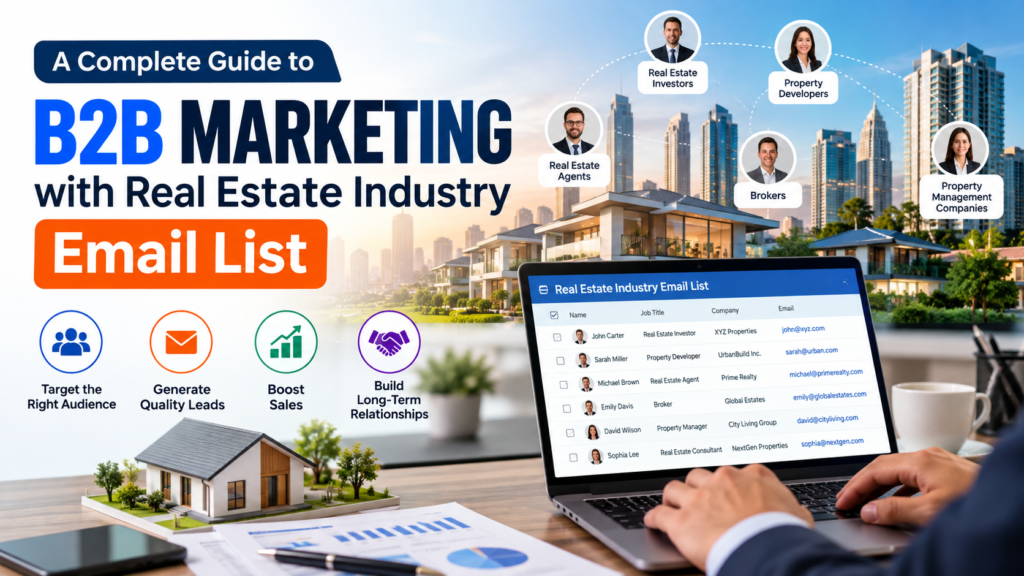
A real estate industry email list is a verified database of business contacts, such as developers, brokers, property managers, investors, and architects, that B2B companies use to email decision-makers directly. Used with segmentation, relevant offers, and compliant outreach, it gives you a faster, lower-cost route into the property sector than cold calling.
This guide covers who you can reach, how to run a campaign step by step, which laws apply, and how to measure results.
What Is a Real Estate Industry Email List?
A real estate industry email list is a curated database of professional contacts working in property, including names, job titles, company details, and verified business email addresses. B2B marketers segment it by role, company size, and location so each message reaches the right buyer instead of the whole market.
It is different from a consumer list of home buyers or renters. The contacts are professionals who buy products and services for their business, such as construction materials, software, finance, legal support, or marketing.
A typical record includes:
- Contact name and job title
- Company name, type, and size
- Business email address
- City, state, and country
- Phone number and website (in many files)
Why Use Real Estate Email Lists for B2B Marketing?
Real estate email lists let B2B marketers reach a concentrated group of decision-makers quickly and at a low cost per contact. The property sector is relationship-driven and project-based, so a targeted email puts your offer in front of the people who approve budgets and choose vendors.
The main benefits:
- Direct access to decision-makers: reach owners, directors, and procurement heads without gatekeepers.
- Precise segmentation: target by role, company type, size, and geography.
- Lower cost than most channels: email costs far less per conversation than trade shows or field sales.
- Measurable results: every reply, click, and meeting can be tracked.
- Supports account-based marketing: build lists around named target companies and send personalized sequences.
Email also works well alongside LinkedIn outreach, webinars, and events, because it gives prospects a place to respond on their own time.
Who Can You Reach With a Real Estate Email List?
You can reach developers, brokers, property managers, investors, architects, and corporate real estate teams. Each group buys different things, so match your offer to the segment.
| Segment | Typical job titles | Often buys |
|---|---|---|
| Developers and builders | Managing Director, Head of Projects, Procurement Manager | Materials, project software, financing |
| Brokers and agencies | Broker-Owner, Sales Director, Team Lead | CRM, lead generation, virtual tours |
| Property managers | Portfolio Manager, Facilities Head | Maintenance, security, PropTech |
| Investors and REITs | Asset Manager, Acquisitions Director | Research, analytics, legal advisory |
| Architects and designers | Principal, Design Director | Design software, materials, furnishings |
| Corporate real estate | Leasing Director, Workplace Head | Fit-out, furniture, workplace technology |
Most providers also let you filter by country, state, city, and company size, which helps when you sell only in certain regions.
Purchased vs. Opt-In vs. Self-Built Lists
Purchased lists are fastest, opt-in lists are safest, and self-built lists are cheapest in cash but slowest to grow. Most B2B teams combine two of the three.
| Factor | Purchased list | Opt-in list | Self-built list |
|---|---|---|---|
| Speed to launch | Immediate | Weeks | Months |
| Upfront cost | Medium | Higher | Low cash, high time |
| Data accuracy | Varies by vendor | Usually high | High if maintained |
| Consent | Often not explicit | Explicit | Explicit |
| Deliverability risk | Higher | Lower | Lowest |
Whichever route you take, ask where the data came from and when it was last verified. A cheap list with stale records will cost more in bounces and damaged sender reputation than it saves.
How to Run a B2B Campaign With a Real Estate Email List
Follow these eight steps to turn a list into booked meetings.
- Define your ideal customer: choose the segment, job role, region, and company size you sell to.
- Vet the list: ask for the data source, verification date, and bounce replacement policy.
- Clean the file: remove duplicates, invalid addresses, and role-based addresses before sending.
- Segment by role and need: a developer and a broker should never get the same email.
- Warm up your domain: start with small daily batches and increase gradually.
- Write one specific email: lead with a problem that segment has, and ask for one action.
- Follow up in a sequence: send three to five emails over two to four weeks, each adding value.
- Test and refine: compare subject lines, offers, and send times, then keep the winners.
What a good first email looks like
Keep it under 120 words. Open with a relevant observation, such as a delay or cost your segment faces. State what you do in one sentence, add a proof point or short case result, and finish with a low-effort question like “Worth a 15-minute call this week?”
A sample subject line for developers: “Cutting handover delays on mid-size residential projects”.
Compliance and Deliverability: What to Know Before You Send
Yes, B2B email is regulated. Anti-spam and privacy laws apply to business contacts in most regions, and the rules differ by country, so check where your recipients are located before you send. This is general information, not legal advice.
- United States (CAN-SPAM): applies to B2B email. You need accurate sender details, a physical postal address, and a working opt-out that you honor promptly.
- EU and UK (GDPR and PECR): B2B outreach often relies on legitimate interest, but you must be transparent about data use and make opting out easy.
- Canada (CASL): generally stricter and consent-based, so cold email needs extra care.
- India: the Digital Personal Data Protection Act, 2023 governs how personal data is processed.
Deliverability basics
- Set up SPF, DKIM, and DMARC on your sending domain.
- Send from a separate domain or subdomain, not your main company domain.
- Gmail and Yahoo require authentication and easy unsubscribe from bulk senders, and expect low spam complaint rates.
- Suppress unsubscribes and bounces immediately and permanently.
Metrics to Track and How to Measure ROI
Track reply rate and meetings booked first, because they show real buyer interest. Open rates are less reliable now that some email apps pre-load images and inflate opens.
| Metric | What it tells you | Rule of thumb |
|---|---|---|
| Bounce rate | List quality | Keep under 2% |
| Spam complaint rate | Sender reputation | Keep under 0.1% |
| Reply rate | Message relevance | Track positive replies separately |
| Meetings booked | Pipeline created | Compare per 1,000 emails sent |
| Cost per meeting | Campaign efficiency | Falls as you refine targeting |
Include the list cost, email tools, and time spent in the total cost, and allow for long sales cycles when attributing revenue.
How to Choose a Real Estate Email List Provider
Choose a provider that discloses its data sources, verifies records regularly, and replaces bounced contacts. Use this checklist before you buy:
- The data source is disclosed (opt-in, public records, directories)
- Verification date and refresh frequency are stated
- Bounced emails are replaced under a written guarantee
- You can filter by role, company type, size, and location
- The provider states how it complies with CAN-SPAM, GDPR, and local laws
- A sample file is available before purchase
- Usage terms are clear (one-time use or unlimited)
- Support is responsive and references are available
Compare cost per verified contact, not the headline price. A smaller, accurate file almost always outperforms a large, stale one.
Real estate industry email lists work best as a targeting tool, not a blast list. Pick one segment, send a specific message, follow up in a sequence, and measure replies and meetings rather than opens.
A practical next step: pilot a small, verified list of a few hundred contacts in one segment, review results after three weeks, then scale what works while keeping every send compliant.
Frequently Asked Questions
Is it legal to use a purchased real estate email list for B2B marketing?
It can be legal, but it depends on where recipients are located and how the data was collected. The US allows B2B cold email if you follow CAN-SPAM, while the EU, UK, and Canada apply stricter consent or transparency rules. Check local law before sending.
How much does a real estate email list cost?
Prices vary by provider, record count, and data depth, and are often quoted per record or per file. Ask for a sample and compare the cost per verified contact, not the headline price, because accuracy decides how much of your spend is wasted.
How accurate are real estate email lists?
Accuracy depends on the data source and how recently records were verified. Even good lists decay as people change jobs, so verify addresses before each campaign and choose a provider that replaces bounced contacts under a written guarantee.
Which metrics matter most for B2B email campaigns?
Reply rate and meetings booked matter most because they show real buyer interest. Open rates are less reliable since some email apps load images automatically. Also watch bounce and spam complaint rates, which protect your sender reputation and future inbox placement.
How many follow-up emails should I send?
Send three to five emails over two to four weeks, spaced a few days apart. Each message should add something new, such as a case result, a useful insight, or a different angle, rather than repeating “just checking in.”
What is the best day to send B2B emails to real estate professionals?
Weekday mornings in the recipient’s time zone are a common starting point, especially Tuesday to Thursday. Treat that as a hypothesis, then test send times on your own segments, since property professionals often spend mornings on site.