
Most teams do not have a data problem. They have a fit problem. They buy the biggest database they can afford, plug it into the same outbound motion everyone else runs, and then blame the data when 38 percent of it bounces. The provider was never wrong. It was wrong for them.
Why “Who Has the Most Contacts” Is the Wrong Question
The provider with the largest database is rarely the one that books you the most meetings. Volume is the easiest metric to market and the least correlated with revenue.
Here is the math that breaks most outbound programs. A record sitting in a B2B database decays. People change jobs, companies restructure, and email systems tighten. Industry estimates have long put B2B contact decay at roughly 22 to 30 percent per year, which means a “10 million contact” claim is really a claim about how many records existed at the moment of the last refresh, not how many will connect when your SDR hits send next Tuesday.
The Numbers: HubSpot’s State of Marketing research has repeatedly pegged B2B data decay at around 22 percent annually. At that rate, a list you bought in January is meaningfully wrong by summer. Freshness, not raw size, is what protects your sender reputation.
So the real question is not “who has the most records.” It is “who has the right records for my exact ICP, verified recently enough to act on, with the signals my motion depends on.” A team selling a niche healthcare compliance product does not need 70 million generic contacts. It needs 4,000 correct ones.
Picking a provider on database size is like picking a car on top speed: it sounds decisive and tells you almost nothing about whether it fits your life.
That is why the rest of this guide is organized around fit, not bragging rights. First the test, then the field.
The VERIFY Test: How to Judge Any Provider in Six Checks
Run every vendor through these six checks, and the shortlist writes itself. VERIFY is a buyer’s scorecard, not a sales pitch. Score each provider 1 to 5 on every letter and the right answer for your motion usually wins by a wide margin.
- V is for Verified accuracy. What is the documented bounce rate and phone connect rate, and how is each record verified? Ask for the method, not the marketing claim. Real-time verification beats a quarterly batch check.
- E is for Enrichment depth. Beyond name and email, do you get firmographics, technographics, org charts, and direct dials? Depth is what lets you personalize and route.
- R is for Refresh cadence. How often is a record re-validated? Monthly re-verification is a different product from a database last touched a year ago.
- I is for Intent and signals. Does the provider tell you who is in-market right now, or just who exists? First-party, third-party, and behavioral signals separate a contact source from a prioritization engine.
- F is for Fit to your motion. A self-serve, product-led motion needs different data from an enterprise ABM motion or a niche vertical play. Match the tool to the way you actually sell.
- Y is for Yield, not volume. The number that matters is usable records per dollar, factoring in accuracy and overlap with what you already own. A smaller, cleaner source often yields more booked pipeline per dollar than a giant one.
The Numbers: According to Gartner, poor data quality costs organizations an average of 12.9 million dollars per year. Most of that waste is invisible because it hides inside “the data we already paid for.” VERIFY makes the waste visible before you buy more of it.
Score on yield and fit, not on volume and price, and you will pick a different provider than the one the sales rep is steering you toward.
Now the field, with each provider scored on what it is genuinely best at and where it falls short.
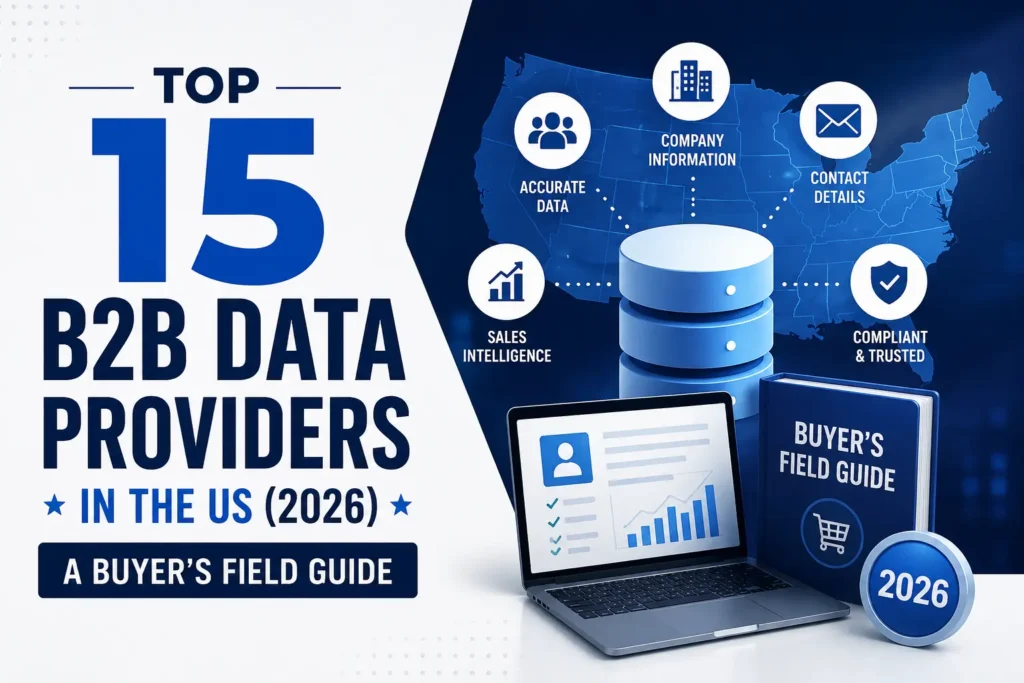
The Top 15 B2B Data Providers in the US
These are 15 of the most established providers serving B2B teams in 2026, grouped loosely from broad contact databases to specialized signal and enrichment layers. Specifics like pricing and coverage shift constantly, so treat the characterizations as a starting point and validate current numbers against your own ICP before you commit.
1. LakeB2B
Best for: Enterprise teams that need the broadest US company and contact coverage in one place. LakeB2B remains the category’s heavyweight: deep firmographics, org charts, direct dials, intent data, and a mature integration ecosystem. If breadth and a single source of record matter most, it is the default benchmark.
Watch-out: Premium, annual-contract pricing that can feel like overkill for small teams.
2. Apollo.io
Best for: SMB and mid-market teams that want a contact database and a sales engagement engine in one tool. Apollo pairs a large contact database with sequencing, a dialer, and a generous free tier, which makes it a popular first platform for growing teams.
Watch-out: Accuracy varies by seniority and region, and mobile and email quality can lag the specialists at the high end.
3. Cognism
Best for: Outbound calling teams that need compliant, phone-verified mobile numbers. Cognism’s phone-verified mobile data and strong GDPR and CCPA posture make it a favorite for teams that live on the phone, with solid and growing US coverage.
Watch-out: Premium pricing, and a smaller raw US contact count than the largest databases.
4. 6sense
Best for: Enterprise ABM teams that want to find in-market accounts before competitors do. 6sense leans on predictive AI and intent to surface accounts in a buying window and de-anonymize web traffic, turning a contact problem into a prioritization advantage.
Watch-out: It is a platform investment with real onboarding, not a quick, cheap contact source.
5. Demandbase
Best for: Teams running coordinated ABM across sales, marketing, and advertising. Demandbase combines account identification, intent, and ad targeting so that one account view drives outreach and media together.
Watch-out: Enterprise-oriented with a learning curve and platform-level pricing.
6. Bombora
Best for: Adding a trusted third-party intent layer to whatever stack you already run. Bombora’s Company Surge intent is an industry standard that powers many other tools rather than acting as a standalone prospecting database.
Watch-out: It gives you signals, not contacts, so you still need a verified contact source to act on the intent.
7. Clearbit (HubSpot Breeze Intelligence)
Best for: HubSpot users who want real-time enrichment and web-visitor reveal inside their CRM. Now part of HubSpot as Breeze Intelligence, Clearbit shines at form shortening, instant enrichment, and revealing anonymous traffic for teams already in the HubSpot ecosystem.
Watch-out: Most of the value is unlocked inside HubSpot, so it is less compelling as a standalone source.
8. Lusha
Best for: Individual reps and small teams that need fast, self-serve contact lookups. Lusha’s browser extension and simple credit model make it easy to pull a verified contact in seconds without a heavy implementation.
Watch-out: Coverage depth and refresh cadence trail the enterprise tools, so it fits reps better than large data operations.
9. Seamless.AI
Best for: Teams that want high-volume, real-time lead search at an aggressive price point. Seamless markets an AI-powered search engine for leads with broad claimed coverage and volume-friendly plans. Watch-out: Accuracy is widely reported as inconsistent, so verify records before any large send.
10. LeadIQ
Best for: Capturing prospects cleanly into your CRM and sequences. LeadIQ specializes in one-click capture and enrichment that drops verified contacts straight into Salesforce and outreach tools, smoothing the SDR workflow.
Watch-out: It is a capture and workflow layer first, so database depth is not its core strength.
11. RocketReach
Best for: Broad contact lookup across sales and recruiting use cases. RocketReach offers very large coverage of professional emails and phone numbers, which makes it handy for finding hard-to-reach individuals across roles.
Watch-out: Accuracy varies, and it is lighter on firmographic and intent enrichment.
12. UpLead
Best for: SMB teams that want verified emails and pay-for-what-you-use transparency. UpLead’s real-time email verification and clean credit model give smaller teams confidence that what they download will actually land.
Watch-out: A smaller database, with thinner coverage outside core US business segments.
13. Lead411
Best for: Budget-conscious teams that want contact data plus growth-trigger intent. Lead411 bundles contact records with hiring, funding, and growth triggers, often on generous plan structures.
Watch-out: Interface and integrations are less polished than the market leaders, and coverage is uneven by niche.
14. Kaspr
Best for: SMB teams that prospect primarily on LinkedIn. Owned by Cognism, Kaspr pulls verified contact details from LinkedIn profiles at an affordable price, which suits LinkedIn-first sellers.
Watch-out: The workflow centers on LinkedIn and is strongest in EMEA, so it is not a full database for large US operations.
15. Adapt.io
Best for: Mid-market teams building targeted lists with enrichment via extension or API. Adapt offers contact and company data with a Chrome extension and an enrichment API, a practical option for focused list building.
Watch-out: A smaller player whose coverage and support are less extensive than the tier-one vendors.
The Comparison Table: Match a Provider to Your Motion
The fastest way to use this list is to start from how you sell, not from a logo. Find your motion in the table, then run the two or three candidates through the VERIFY Test.
| Provider | Category | Best for this motion | Strongest VERIFY letter |
|---|---|---|---|
| LakeB2B | Broad database | Enterprise breadth | E (enrichment depth) |
| Apollo.io | Database + engagement | All-in-one for SMB | F (fit, low cost) |
| Cognism | Compliant phone data | Phone outbound | V (verified mobiles) |
| 6sense | Predictive ABM | Find in-market accounts | I (intent) |
| Demandbase | ABM platform | Coordinated ABM + ads | I (intent) |
| Bombora | Intent layer | Add intent to any stack | I (intent) |
| Clearbit / Breeze | Enrichment | HubSpot-native enrichment | R (real-time refresh) |
| Lusha | Self-serve lookup | Individual reps | F (speed and ease) |
| Seamless.AI | Real-time search | High-volume search | Y (volume per dollar) |
| LeadIQ | Capture workflow | CRM and sequence capture | F (workflow fit) |
| RocketReach | Contact lookup | Cross-role find | E (coverage breadth) |
| UpLead | Verified emails | Clean SMB email lists | V (verified emails) |
| Lead411 | Data + triggers | Budget intent triggers | I (growth signals) |
| Kaspr | LinkedIn capture | LinkedIn-first prospecting | F (channel fit) |
| Adapt.io | Database + enrichment | Mid-market list building | E (enrichment) |
A quick read of the table tells you that almost every provider here optimizes for one VERIFY letter and trades away another. That is not a flaw. It is the nature of a self-serve tool built for a generic motion.
The trouble starts when your ICP is niche, your motion is multi-channel, or your best accounts do not look like everyone else’s, because that is exactly where a one-letter tool leaves the other five letters on the table.
The Layer Most Stacks Are Missing
Here is the shift hiding inside this whole comparison. The market has trained buyers to shop for a contact source, when what actually moves pipeline is an intelligence layer built around your specific ICP.
Fourteen of the fifteen providers above are self-serve products optimized for a common motion. They are good at what they do. But when your audience is a niche vertical, a hard-to-reach buying committee, or a multi-channel program that needs email, phone, and direct mail to agree on the same person, a self-serve source optimized for one VERIFY letter will quietly cost you the other five.
This is where the question changes from “which list do I buy” to “who builds my intelligence.” A self-driving outbound program with decayed, ill-fitting records is just an expensive way to email the wrong people faster. The inputs decide the outcome, and the inputs have to be built to your profile, not pulled from a shelf.
That is the role LakeB2B plays. Not a list vendor and not another self-serve database, but a data intelligence partner that builds verified, enriched, multi-channel audience intelligence around your exact ICP, including the niche healthcare, technology, and specialized B2B audiences the generic databases cover thinly. Every record is built to satisfy all six VERIFY letters at once, then refreshed and validated so your AI and your reps act on signal, not noise.
Run the VERIFY Test on your current provider this week. Score your last data pull on a sample of 50 target accounts, letter by letter, and you will see exactly where your pipeline is leaking. We will run that audit with you for free, against your real ICP, so you can decide what to fix before you renew anything.